
Has this ever happened to you? You’re mid-presentation on a Zoom call, the client is finally asking the right questions, and then suddenly your screen freezes. You wait because you think it’s just latency, then the audio cuts out and you’re left talking to yourself.
For homeowners across rural Maryland and Virginia, this is all too familiar. Spotty internet is a daily battle that costs you time, money, and more than a little sanity. However, there is a solution, and it’s already working on rooftops across the region. This guide walks you through why Starlink satellite internet is the answer for rural homes and why professional installation is the part most people overlook until it’s too late.
Why Your Internet Signal Keeps Dropping
This is an age-old problem. But before we talk about solutions, let’s look at why this happens in the first place.
Rural homes in the DMV sit miles from the nearest cable infrastructure. That distance alone puts you at a disadvantage. Add in thick tree lines, rolling hills, and unpredictable Mid-Atlantic weather, and you’ve got a recipe for the kind of spotty internet service that makes streaming, working, and even basic browsing feel like a gamble.
Here’s what’s actually working against you:
- Distance from infrastructure. Cable lines stop well short of most countryside homes. You’re simply too far out for traditional providers to reach reliably.
- Weather interference. Rain, snow, and heavy cloud cover scramble wireless signals. A storm rolls in over Loudoun County, and suddenly your connection disappears.
- Trees and terrain. Thick woods and hills are beautiful until they’re sitting between you and the nearest cell tower.
- Overloaded networks. Rural towers serve large areas with limited bandwidth. During peak hours, everyone’s competing for the same signal. Some get it, and others don’t.
Want to test this for yourself? Run a speed test tonight around 7 p.m. That’s when networks are most congested. If you’re under 25 Mbps like nearly 40% of rural homes, it’s time for Starlink. Many rural U.S. homes fall short of the FCC’s 100/20 Mbps broadband standard.
The best way to figure out if you’re ready for an upgrade is to schedule a free roof assessment.
Starlink: The Satellite Solution Built for Rural Homes
Think you’re too far out for decent signal? Starlink doesn’t care how far you are from the nearest cable line. It bypasses ground infrastructure entirely by connecting your home to a network of low-orbit satellites circling overhead. The result? Speeds between 50 and 400 Mbps, delivered directly to a dish mounted on your roof, regardless of whether you’re in a suburban neighborhood or on 50 acres outside Fredericksburg.
What makes Starlink different from older satellite options is the technology behind it. Low-earth orbit means less signal delay, faster response times, and more consistent performance. The dish even has built-in snow-melt technology, so a February storm in Rockville doesn’t knock you offline the way it used to.
Starlink Plans Quick View
| Plan | Speed | Price | Best For |
| Residential | 100–400 Mbps | $50–120/mo | Primary homes |
| Roam | 50–200 Mbps | $50–165/mo | Farms and RVs |
Hardware: ~$349 dish. Check your DMV address at starlink.com.
For rural homeowners who’ve spent years working around spotty internet service, Starlink feels like a completely different world.
Even The Best Equipment Can’t Save You With a Poor Installation
Here’s where a lot of homeowners lose money they didn’t have to spend.
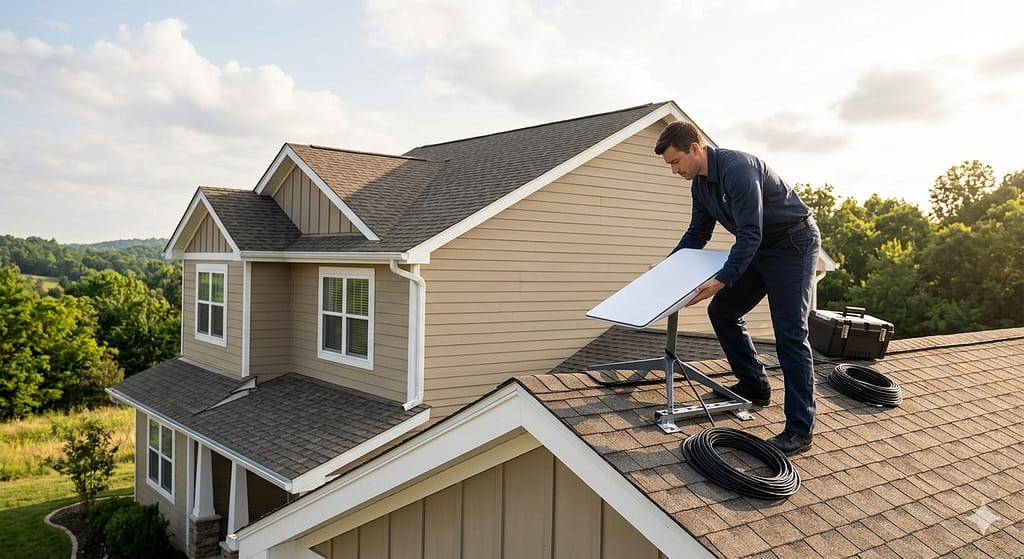
Starlink’s dish is impressive technology, but it’s only as good as where and how it gets mounted. The dish needs a clear, unobstructed view of the sky. A few degrees off the optimal angle, and your signal weakens. A shaky mount that shifts after one good windstorm, and you’re back to square one. A roof penetration that wasn’t properly sealed, and now you’ve got a leak working its way through your attic.
Homeowners who attempt DIY installation often spend $500 or more correcting mistakes, sometimes more than the professional installation would have cost in the first place. How real is this scenario? One wrong bracket, one missed obstruction in the tree line, and you’re climbing back up on the roof to start over.
Getting a professional installation can prevent 90% of early performance issues. That’s not a marketing claim; that’s what happens when someone who knows your roof type, your local weather patterns, and your property’s terrain handles the job from the start.
5 Reasons Pro Installation Beats DIY Every Time
If we were having this conversation sitting at your kitchen table, this is how it would go. Before any work begins, we make sure you understand the process from beginning to end. That means discussing the important points upfront, including the following:
1. Optimal Placement We scan your entire roof and surrounding property to find the single best placement for your dish, factoring in tree lines, roof pitch, and sky exposure. DIY placement misses the optimal spot about 30% of the time.
2. Secure Mounting Our anchors are built to handle winds up to 80 mph, which matters when you’re sitting in the middle of a Front Royal summer storm. Standard hardware-store brackets aren’t designed for that kind of load.
3. Weatherproofing Every roof penetration we make gets properly sealed. Starlink installation pairs naturally with our roof tune-up services, and we treat every entry point like it needs to last 25 years because it does.
4. Signal Testing Before We Leave We don’t pack up until we’ve confirmed your signal strength using both the Starlink app and our own tools. Our standard is 150 Mbps or better before we call the job done.
5. Warranty Protection Factory-certified installation keeps your one-year Starlink warranty fully intact. A DIY install can void that coverage without you realizing it until something goes wrong.
Our team has been on rooftops across the DC Metro Area for 40 years. We’ve served more than 30,000 homeowners, and we bring that same care to every Starlink installation we do.
Real Homeowners, Real Results
Families often try to work around spotty internet service for years, downloading files before bed and hoping uploads finish by morning. One professional installation can change that. We’ve seen Loudon County farms jump from 5 Mbps DSL to 250 Mbps after installation. Users report 87-243 Mbps in Southwest VA (Starlink map) vs. typical 5-25 Mbps DSL.
Before: spotty frustration, missed deadlines, buffering at dinner.
After: seamless connections, clear Zoom calls, movie nights that actually finish.
End Spotty Internet for Good
Spotty internet steals hours from your day and patience from your household. Starlink satellite internet delivers the reliability that rural Virginia and Maryland homes have needed for years, and professional installation makes sure it performs the way it’s supposed to for the long haul.
Start by checking your availability online at Starlink, then reach out to us. Contact American Home Contractors for a free roof assessment and Starlink installation quote. You’ll love having clear, problem-free internet service.
